
The 2027 Water Heater Rule: What San Francisco Owners Should Know
By the MC2 Electric team · Last reviewed October 14, 2026 · 7 min read
- What: Bay Area air district rules phase out new gas water heaters and furnaces that emit nitrogen oxides (NOx). Small water heaters are first, currently set for January 1, 2027.
- Who it affects: anyone replacing a water heater in San Francisco and eight other Bay Area counties. Working appliances can stay.
- What’s pending: the board votes November 4, 2026 on moving the small water heater date to 2028 and adding exemptions, including one for homes with electrical constraints.
- What to do now: find out how old your water heater is and whether your panel has room. Then the decision is yours to make on your own schedule, not in an emergency.
Most people think about their water heater once a decade, usually on the morning it fails. That habit is about to get expensive in the Bay Area. Air district rules adopted in 2023 change which water heaters can be sold and installed here, starting with ordinary home tank units. The details are still moving, and the regional board meets on November 4 to vote on changes. Here is what is settled, what is still open, and what it means for the wiring in a San Francisco home or apartment building.
What the rule actually says
The Bay Area Air Quality Management District (BAAQMD) adopted amendments to two rules in March 2023. Regulation 9, Rule 6 covers water heaters and boilers. Regulation 9, Rule 4 covers furnaces. Both set zero-NOx standards, which in practice means electric heat pumps. Gas burners can’t meet the limit.
| Appliance | Adopted date (in force today) | Proposed in July 2026 draft |
|---|---|---|
| Water heaters under 75,000 BTU/hr (typical home tanks) | January 1, 2027 | January 1, 2028 |
| Residential and commercial furnaces | January 1, 2029 | Under review in a later phase |
| Larger water heaters and boilers, including tankless (75,000 to 2 million BTU/hr) | January 1, 2031 | January 1, 2033 |
Three points are often misunderstood:
- It is not a removal mandate. No one has to take out a working gas water heater or furnace. The rule bites only at replacement.
- It works by manufacture date. Units manufactured after the compliance date can’t be sold or installed in the district. Older stock can still be installed.
- Stoves and dryers are not covered. This rule is about water and space heating only.
The district covers San Francisco, Alameda, Contra Costa, Marin, San Mateo and Santa Clara counties, plus southwestern Solano and southern Sonoma.
The November 4 vote
In July 2026 the district published draft “flexibility amendments” to Rule 9-6. They respond to concerns from housing providers, tenant advocates and some board members, and the board is split. The draft would:
- Move the small water heater date from 2027 to 2028, and the large unit date to 2033.
- Exempt water heaters under 30 gallons, because zero-NOx models that small aren’t widely available.
- Give more time to hydronic systems, and to multifamily and deed-restricted affordable housing.
- Provide relief for high hot-water users such as restaurants, healthcare and dry cleaners, and for qualifying low-income owners.
- Allow a one-time electrical constraint exemption. It would apply, for example, where knob-and-tube wiring would need long new conduit runs, where a panel is under 100 amps (under 60 amps per unit in buildings with five or more units), where a new 240-volt run would exceed 50 feet, or where there is no breaker space.
- Let a licensed contractor install a temporary “loaner” gas heater in an emergency, to be replaced with a compliant unit within 12 months.
Key dates: public comments close November 1, 2026 at 6 PM, and the board is scheduled to consider adoption on November 4, 2026. Until the board acts, January 1, 2027 remains the date in force. We will update this article after the vote.
The electrical side of a heat pump water heater
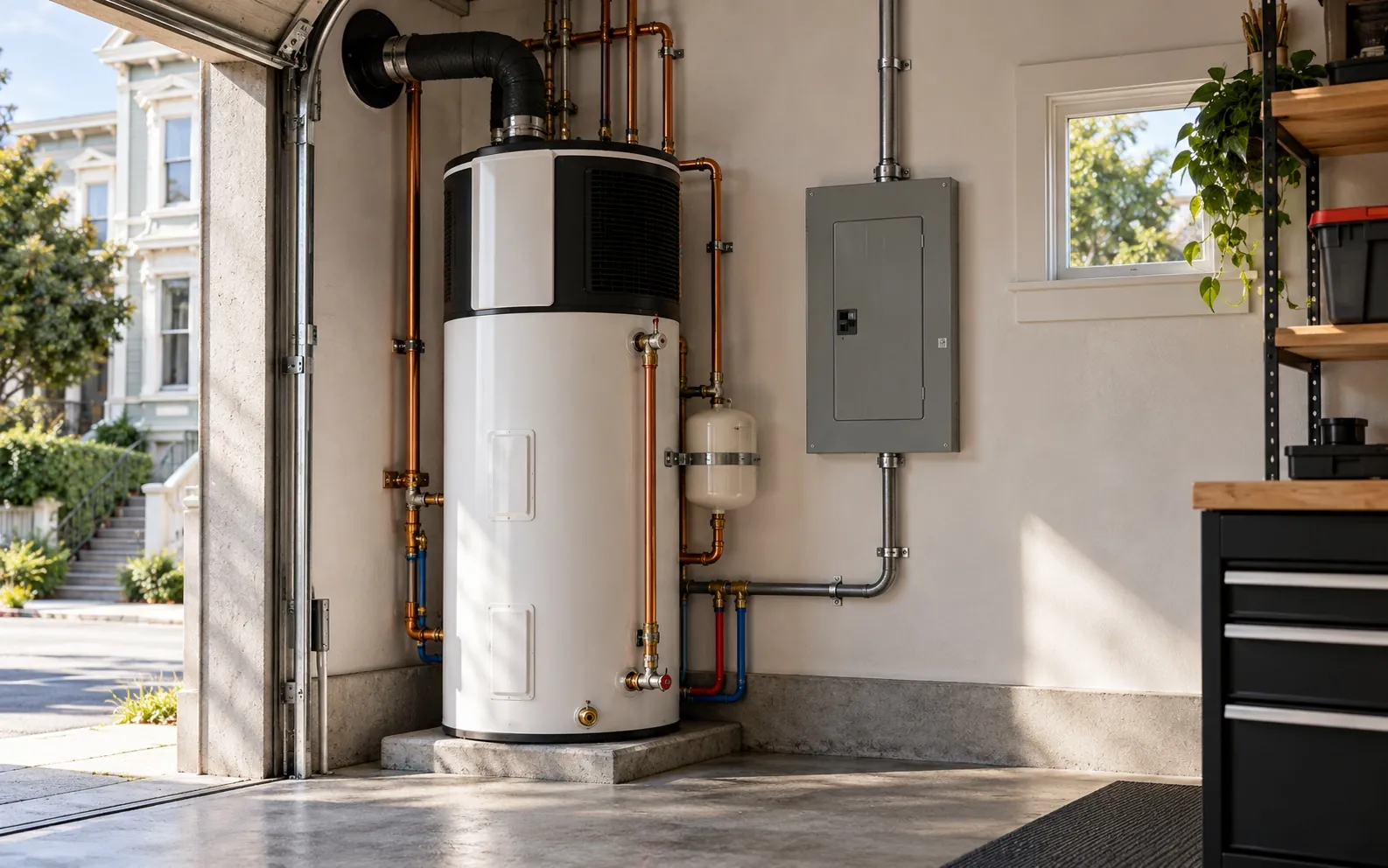
A heat pump water heater (HPWH) moves heat from the surrounding air into the tank, which is why it uses far less electricity than an old electric-resistance tank. What it needs from your electrical system depends on the model:
| Type | Typical circuit | Good fit for | Trade-off |
|---|---|---|---|
| 120V plug-in | Standard 15A or 20A receptacle, sometimes shared | Flats and homes with a full panel or long wire runs | Slower recovery, so it may need a larger tank or mixing valve |
| 120V dedicated | Dedicated 15A or 20A circuit | Most homes with modest breaker space | Still slower recovery than 240V |
| 240V hybrid | Typically a 30A, 240V circuit | Larger households, homes with panel capacity | Needs two breaker spaces and a heavier wire run |
The air district’s own July 2026 overview highlights 120-volt units as a way to avoid a new 240-volt circuit. It also notes that many California homes have mid-sized panels: about a third of single-family homes have 100 amps, and most multifamily units have 60 amps. Those homes can often electrify through right-sizing, circuit sharing or smart panels instead of a full service upgrade.
Beyond the wiring, a heat pump needs air and a condensate drain. Check the manufacturer’s space and ventilation requirements before you commit to a closet location. Some units can be ducted, and that matters in San Francisco’s compact utility closets.

Most water heater replacements in San Francisco are not blocked by the heat pump. They are blocked by not knowing what the panel can take. A one-hour assessment usually answers that.
San Francisco buildings are different
The city’s housing stock creates specific situations we see every week:
- Victorian and Edwardian flats often keep water heaters in a garage or rear service area, with each unit on its own small panel. A 120-volt unit can be the difference between a simple swap and a multi-unit electrical project.
- Knob-and-tube wiring still turns up in Noe Valley, the Richmond and the Sunset. Adding a new circuit is a good moment to plan the rest of the rewire. See our knob-and-tube retrofit guide.
- Apartment buildings with a central boiler fall under the larger-equipment dates (2031, or 2033 if the amendments pass). A central heat pump plant takes planning, structural review and often a PG&E service change. Start early.
- Garages and basements are usually good homes for heat pumps because they have air volume. Interior closets may need louvered doors or ducting.

Costs and incentives in 2026
Costs vary with location, wiring and venting changes. Published San Francisco figures put a heat pump water heater installation at roughly $6,000 to $9,000, compared with about $2,000 to $3,000 for a like-for-like gas tank. Incentives narrow the gap, but they change often:
| Program | What it offers | Status (October 2026) |
|---|---|---|
| CleanPowerSF heat pump water heater credit | Bill credit reported at $50/month for two years (longer for CARE/FERA households) with demand-response enrollment | Check current terms with CleanPowerSF |
| SF Environment Climate Equity Hub | Free HPWH for qualifying households at or under 80% of area median income replacing an older gas unit | Income-qualified; check availability |
| TECH Clean California | Contractor-delivered rebates | Single-family reservations closed December 2025 |
| Federal 25C tax credit | Was 30% up to $2,000 | Ended for equipment installed after December 31, 2025 |
For the full picture of what is left after the federal credits ended, see our guide to San Francisco incentives in late 2026.
A calm plan for the next 12 months
- Find the age of your water heater. The serial number on the label encodes the manufacture date. Units older than about 10 years are living on borrowed time.
- Photograph your panel. Note the main breaker size and whether there are empty spaces. That one photo answers half the questions.
- Get a load assessment. An electrician can tell you whether a 120V or 240V unit fits, and whether a measured load study (NEC 220.87) avoids an upgrade. See electrifying without a service upgrade.
- Decide before it breaks. If a heat pump makes sense, consider running the circuit now so a future swap is a one-day job.
- Landlords: inventory every unit. List tank ages, locations and panel sizes per unit. Exemptions, if adopted, will need documentation.
- Watch the November 4 decision and check incentive status before you sign a contract.
Questions we hear often
Do I have to replace my working gas water heater in 2027?
No. The rule applies only when a water heater is replaced. Units manufactured before the compliance date can still be installed, and nobody is required to remove a working appliance.
Is the Bay Area water heater rule being delayed to 2028?
It may be. A July 2026 draft proposes moving the small water heater date from January 1, 2027 to January 1, 2028 and adding exemptions. The BAAQMD board is scheduled to vote on November 4, 2026. Until then, 2027 is the date in force.
What happens if my water heater fails and I can't get a heat pump right away?
The draft amendments would allow a licensed contractor to install a temporary gas loaner heater in an emergency, to be replaced with a compliant unit within 12 months. That provision only applies if the board adopts it.
Will a heat pump water heater require a panel upgrade?
Often not. 120-volt plug-in models use a standard circuit, and many 240-volt units fit within existing capacity. A measured load study can confirm what your panel can handle before you pay for a service upgrade.
Does the rule ban gas stoves or dryers?
No. Regulation 9 Rules 4 and 6 cover water heaters, boilers and furnaces only.
Sources and further reading
We checked the facts in this article against these primary sources. Rules, rates and incentives change, so confirm current details before you make a decision.
- BAAQMD: Building appliance rule implementation
- BAAQMD: July 2026 Rule 9-6 draft amendments announcement
- BAAQMD: Building appliances rule development documents
- Axios San Francisco: Bay Area heat pump rebates (September 2026)
- TECH Clean California news
This article is general information for San Francisco readers, not legal, tax or engineering advice for a specific property.